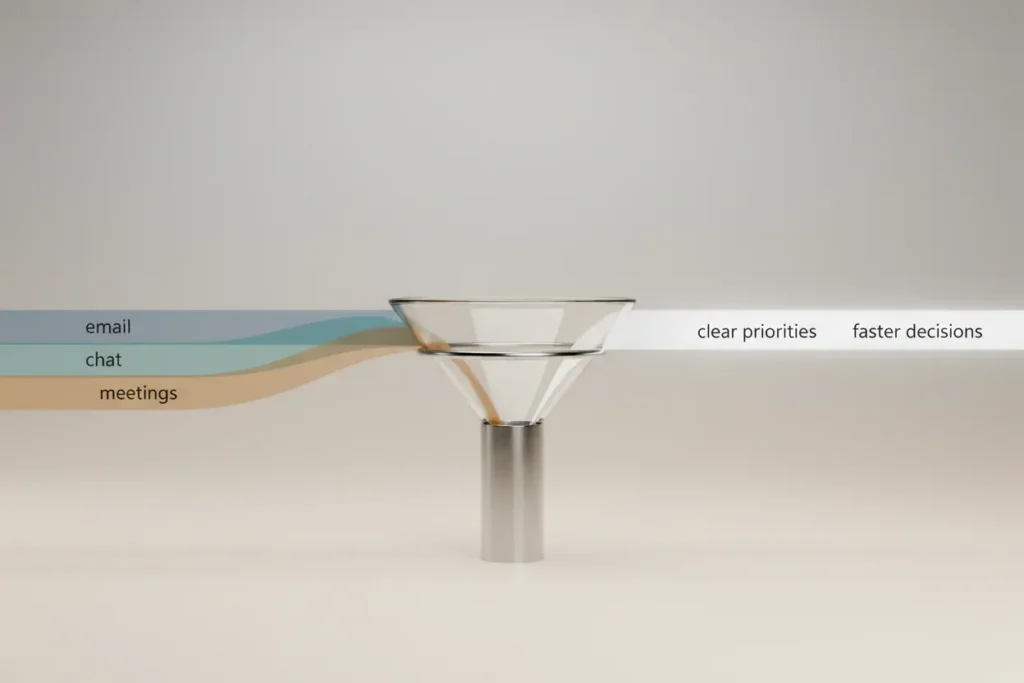
Cut Noise in Team Communication Across Email, Chat, and Meetings
Teams waste hours every week untangling scattered messages, surprise meetings, and endless reply chains. This article brings together 25 tested strategies and expert insights to cut communication clutter across email, chat, and meetings. The tactics work for clinical teams, remote startups, and traditional offices alike.
- Record Client Directives in Tasks
- Give Each Channel One Job
- Create a Dedicated Approval Thread
- Switch to Short Async Video Updates
- Set a Four-Hour Reply Window
- Name a Single Communication Lead
- Mandate Briefs Before Meetings
- Declare Interruption-Free Thursdays
- Use Standard Message Prefixes
- Require Owner, Choice, and Deadline Upfront
- Batch Inbox Replies Twice Daily
- Limit Participants to Essential Contributors
- Teach Plans Live to Reduce Noise
- Separate Blockers Into a Dedicated Urgent Lane
- Start Discussions With a Question and Summary
- Run Daily Fifteen-Minute Standups
- Install Automatic Escalation Tiers
- Tie Messages to Active PDCA Steps
- House SEO Sign-Offs in Slack
- Publish a Proposal Before Any Call
- Model Healthy Response Boundaries
- Keep Patient Items in EMR Only
- Hold Regular Office Hours
- Centralize Announcements and Curb Side Chats
- Define Prework and Scope for Sessions
Record Client Directives in Tasks
One rule fixed it: every client decision lives in the project management tool, and nothing decided anywhere else exists until it is written back into the task. We run everything through ClickUp.
Clients still send WhatsApp messages and still say important things on calls; fighting that is pointless. What changed is what we do with it. Whoever receives the decision writes it into the relevant task, and until that happens, it has not been decided.
The noise reduction came from an unexpected direction. Most channel noise is not extra messages, it is the same question asked three times because the answer lives in someone’s inbox. Once the task became the single source of truth, the repeated questions died off on their own.
Decisions actually got faster, which is the part people doubt when I describe this. The fear is that writing things down adds friction. In practice the opposite happens: anyone can open the task, read the full context, and act without waiting for the one person who was on the call.
One channel per purpose is the norm we hold. Chat is for urgency; the task is for decisions. The speed was never in answering fast. It was in never needing to reconstruct what had already been answered.

Give Each Channel One Job
The single change that moved the needle: I gave each channel one job and stopped letting them overlap. Chat is for blockers only — something is stuck, who can unstick it, and every message has to include what’s needed and by when. Email is for decisions that need a paper trail. Async docs (Notion, Loom) carry everything else: context, thinking, proposals. No “quick thought” threads in chat, no decisions buried in DMs. Non-blockers in chat get redirected to a doc link rather than answered inline.
What I stopped doing was treating Slack as a place to think out loud. Once that went away, response time dropped but decision quality went up, because people had to form an actual position before they typed. The trade-off is real: it feels colder, and you lose some casual idea-bouncing. I offset that with a weekly systems review where loose ideas get a proper home — same audit cadence I run on every system, good weeks or bad. Running two brands in parallel, this is the rule that kept decision lag from compounding across both.

Create a Dedicated Approval Thread
I created a dedicated decisions thread in my team’s chat. Everything else can wait until someone checks in on their own time. Before that, my team was treating every ping as equally urgent, so the things that needed quick action got buried in the scroll.
We set a four-hour response window on that thread. It gave people enough breathing room to finish deep work before weighing in, and it created a clear paper trail so nobody had to re-ask “wait, did we decide on this?” in a meeting later. We cut several recurring meetings within a few weeks because half of them existed just to re-hash decisions that had already been made across scattered chat threads.
The single change that mattered most was agreeing as a team that “seen” doesn’t mean “handled”, and that a few hours of silence on a decision is fine. The decisions thread became the single source of truth for anything that needed a yes or no.

Switch to Short Async Video Updates
The single change that made the biggest difference was replacing our weekly standups with two-minute asynchronous video updates from each team lead. Each update covers wins, blockers, and priorities so people can watch on their own time and add context in comments, which preserves decision momentum without constant interruptions. That shift removed meeting fatigue and improved clarity while letting quieter team members engage more thoughtfully. It also created a searchable library of progress that helped onboarding and made retrospectives more grounded. I recommend teams experiment with a similar short, structured async cadence rather than adding more meetings.

Set a Four-Hour Reply Window
Running two companies remotely between Bali and Tallinn, async communication isn’t optional, it’s survival.
The single biggest change was killing the expectation of fast replies on chat. We set a 4-hour response window as the default. No one needs to explain why they didn’t reply in 10 minutes. That one shift cut the compulsive checking, and weirdly, decisions actually got faster because people stopped waiting for permission and just moved.
The other thing that helped was being ruthless about where decisions live. Chat is for quick context. Email is for things that need a paper trail. If something actually needs a meeting, write the decision doc first, meet only to disagree or commit.
Pageloot has always been lean, so we never had the budget to have coordination overhead. That forced discipline early. When your team is spread across time zones, you figure out fast that synchronous meetings are expensive and most of them are just status updates that could be a two-line Slack message.
The noise reduction wasn’t a tool change. It was a norms change. Agreeing upfront on what “urgent” actually means, and making it rare, fixed 80% of the problem.

Name a Single Communication Lead
The single change that made the biggest difference was assigning one communication owner per issue. Too often, cross-channel noise happens because several people are updating, nudging, and interpreting the same topic at once. I set a rule that every active decision had one owner responsible for consolidating input, issuing updates, and recording the outcome. That reduced duplication immediately.
I found it also changed team behaviour in a healthy way. People stopped broadcasting half-formed progress across multiple channels and started feeding relevant information to the owner. Meetings became cleaner because accountability was obvious, and chat became less chaotic because not everyone felt responsible for narrating movement. Clear ownership turned communication from a stream of commentary into a more disciplined operating system.

Mandate Briefs Before Meetings
We cut noise by making meetings earn their place. If a topic only needs an update or a clear yes or no, then we do not turn it into a meeting. We ask the owner to share a short written brief with the decision needed, the options considered, and the reply deadline. This gives everyone time to think and keeps meetings for topics that truly need discussion.
This approach shortened our calendar and improved the quality of decisions. Written briefs create a clear record and reduce repeated conversations across different channels. They also give quieter team members more time to share thoughtful ideas. We still meet often enough to stay aligned, but we no longer use meetings to make up for unclear communication.

Declare Interruption-Free Thursdays
In order to maintain a fast pace of decision making in spite of communication noise, I have enforced an unbreakable “no-meeting” Thursday rule for my office employees. The difficulty in getting actual work completed when a team has their entire day divided among chat, emails and video calls is quite high. We will have no internal meetings on Thursdays, and the use of chat is limited solely to any urgent or immediate issues with the facilities.
As a result of this one adjustment, my Administrative Coordinators are able to take advantage of a full day without interruptions to focus exclusively on processing complex documents and completing all scheduling updates. Ultimately, as a result of giving our team members dedicated quiet time to focus on work, we were able to improve our overall workflow speed while also sharpening our decision making.

Use Standard Message Prefixes
I reduced the amount of digital noise we receive from internal email updates and instant messaging, without reducing the speed of operation of our day-to-day activities through implementing standardized prefixes to all our internal communications. In addition, in order to maintain consistency across our entire team, our administrative staff is required to start each of their internal communications (emails and/or chats) with one of the three pre-defined standardized prefixes such as [Action Required], [Decision Needed], or [FYI Only] so that coordinators and other internal staff members can easily view and process all incoming messages in chronological order.
By simply adding this one element to our internal communication protocols, coordinators no longer need to drop everything to check every single update that is sent out via email or chat, which helps keep our day-to-day facility logistics running smoothly. As a result of being able to quickly identify the messages that require my personal decision/approval (and subsequently respond to those messages promptly), I am able to continue maintaining perfect organizational structure behind the scenes.

Require Owner, Choice, and Deadline Upfront
The biggest change for us was agreeing that not every message deserves the same speed of reply. In my clinic work, Office Hours, and wholesale conversations with pharmacies, I’ve seen how quickly decisions stall when people treat email, chat, and meetings as one big pile. We made one rule: if a decision is needed, the message must say who owns it, what decision is needed, and when it’s needed by. Anything clinical or time-sensitive gets a direct call. Anything that needs thought goes into email. Chat is for quick checks, not long debates. That one shift reduced the back-and-forth because people stopped guessing. My advice is to stop asking your team to “keep up” and start teaching them how to signal urgency clearly. Most noise comes from unclear expectations, not from too many tools.

Batch Inbox Replies Twice Daily
I minimize digital distractions by changing how people view the expectation of responding to emails quickly. The largest amount of distraction for my administrative team came from them constantly switching between chat notifications and checking their inbox throughout the day. I changed this by implementing two thirty-minute blocks of time each day, when the administrators can respond to email—morning and afternoon. At times outside of these blocks, our administrators do not have access to their email tab. They then solely focus on their primary workflow.
By removing the expectation of an instant response to every email request, we make decisions much quicker. We are able to process requests in batches rather than individually. Our daily facility coordination runs smoother with fewer distractions. Additionally, this allows everyone a quiet block of time, so that they may be more efficient.

Limit Participants to Essential Contributors
The biggest difference came from removing hidden audiences. In complex organizations, too many people are copied into every conversation because nobody wants to exclude the wrong stakeholder. That creates performative communication, where messages are written for visibility rather than usefulness. The norm that changed this was narrowing participation aggressively. Every thread, chat group, or meeting needed a named decision owner and only essential contributors.
I found that smaller communication circles improved both speed and quality. People gave sharper input when responsibility was clear, and others were not pulled into discussions that did not require their judgment. Escalations became cleaner because ownership was visible from the start. Noise often comes from social caution, not operational necessity. Once participation became intentional, decisions accelerated without the organization feeling less informed.

Teach Plans Live to Reduce Noise
The single change that reduced noise without slowing decisions was shifting from passive communication to direct employee education and prioritizing in-person enrollment meetings. Instead of sending materials and waiting for questions, we walk employees through plan options, explain deductibles and out-of-pocket exposure in plain terms, and leave space for questions. When in-person sessions are not possible, we use structured virtual meetings that follow the same format. That approach cut back-and-forth email and chat, and helped employees make decisions confidently during the session.