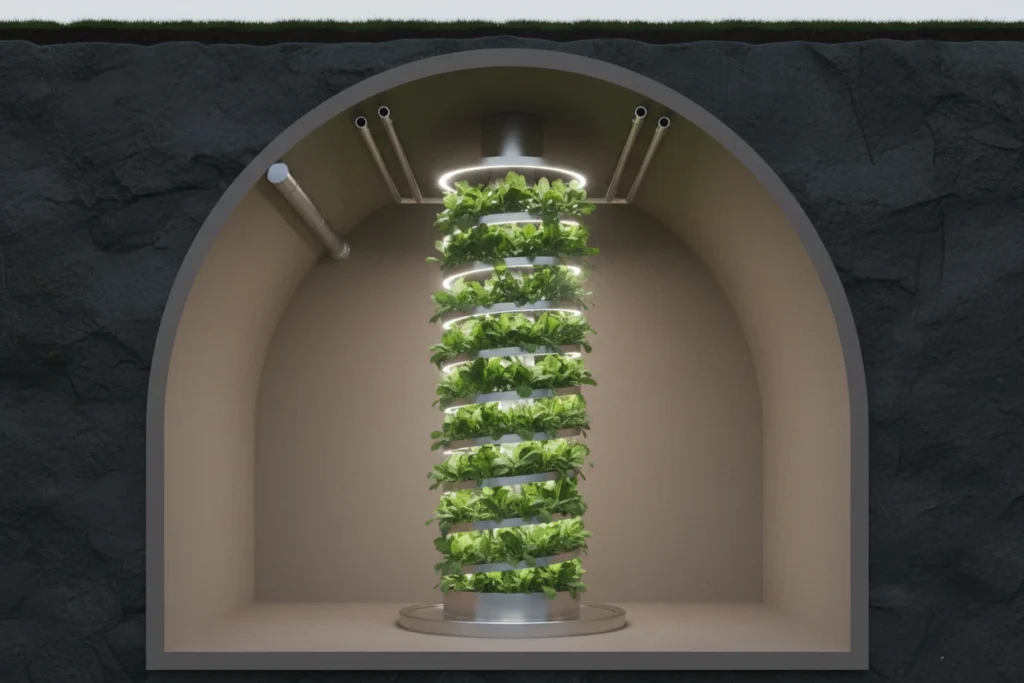
The Deep Green Revolution: Using Subterranean Voids for Hyper Efficient Agri Infrastructure
By C.D. Lawrence
The global food system is breaking. Climate volatility is destroying crops. Arable land is disappearing. Freshwater is running dry. And we’re supposed to feed 10 billion people by 2050.
The math doesn’t work.
But there’s a solution hiding in plain sight: abandoned mines. Repurposed into climate-controlled vertical farms powered by renewable energy, these subterranean voids could transform food security while creating a new asset class for real estate investors. The convergence is elegant. The opportunity is massive. And the time window is now.
TL;DR: The Solar Kitties Framework
The Problem: Traditional agriculture consumes 70% of global freshwater and occupies 50% of habitable land, yet faces existential threats from climate change, land scarcity, and water depletion. The current system cannot scale to feed 10 billion people sustainably.
The Solution: Repurposing abandoned mines into hyper-efficient, climate-controlled vertical farms using hydroponics, aeroponics, and AI-driven automation. Subterranean environments provide natural insulation, constant temperatures, and protection from pests and pathogens—drastically reducing energy costs compared to surface-level indoor farms.
The Opportunity:
- Global food market: $1.8 trillion
- Vertical farming market growing from $4.2B (2024) to $18.9B (2032) at 19.3% CAGR
- Subterranean agri-infrastructure: nascent but accelerating, with pilot projects in UK, Germany, and Australia
- Real asset play: Abandoned mines valued at $50B+ globally, now becoming productive infrastructure
The Investment Thesis:
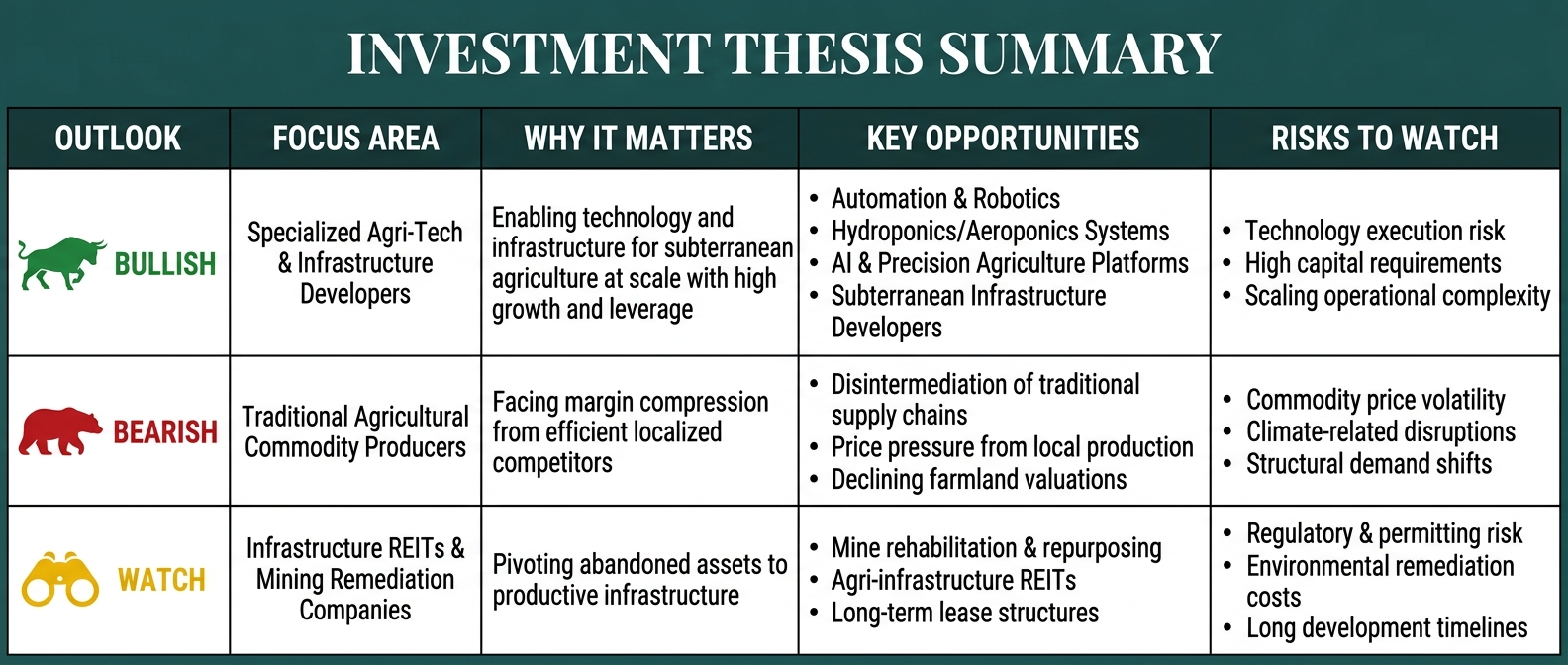
- BULLISH on specialized agri-tech firms (automation, hydroponics, AI systems) and infrastructure developers capable of scaling subterranean operations
- BEARISH on traditional agricultural commodity producers facing margin compression from localized, efficient competitors
- WATCH for infrastructure REITs and mining remediation companies pivoting to agri-tech
I. The Problem: Why Traditional Agriculture Is Broken
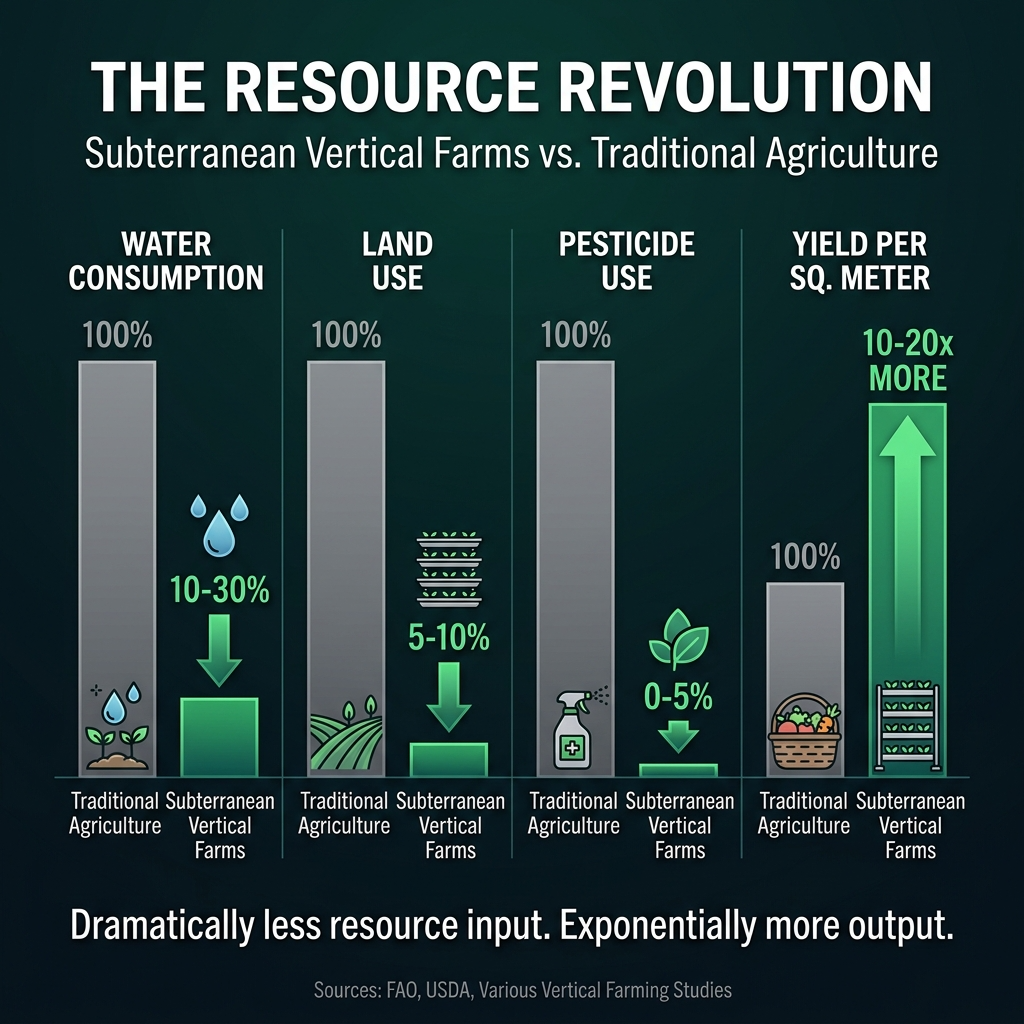
Every year, we lose 24 billion tons of fertile soil to erosion and degradation. Every year, freshwater aquifers drop by 2.5 meters on average. Every year, climate volatility destroys $100+ billion in crops.
The numbers are not theoretical. They’re arithmetic.
Traditional agriculture is a resource extraction machine. It consumes vast quantities of water, land, and energy to produce food that travels thousands of miles before reaching your plate. The system works—barely—only because we’ve been mining the planet’s natural capital at an unsustainable rate.
Here’s the cascade:
Climate Volatility → Unpredictable weather patterns destroy crops, creating price spikes and supply shocks. Droughts in the American Midwest ripple through global grain markets. Floods in Bangladesh devastate rice production.
Arable Land Loss → Urbanization, desertification, and soil degradation shrink the productive land base. We’re losing 10 million hectares of arable land annually—equivalent to the size of Iceland.
Freshwater Depletion → Agriculture accounts for 70% of global freshwater extraction. Major aquifers like the Ogallala Aquifer (North America) and the Indus Basin (South Asia) are being drained faster than they recharge. Some will be exhausted within decades.
Food Insecurity → The result is a fragile system. A single climate event can trigger regional food shortages. Supply chain disruptions cascade globally. Prices spike. Populations destabilize.
The global food market is $1.8 trillion annually, yet it operates on increasingly shaky ground. We need a paradigm shift. We need to decouple food production from climate, geography, and resource scarcity.
Enter the subterranean solution.
II. The Technology: Mining the Future
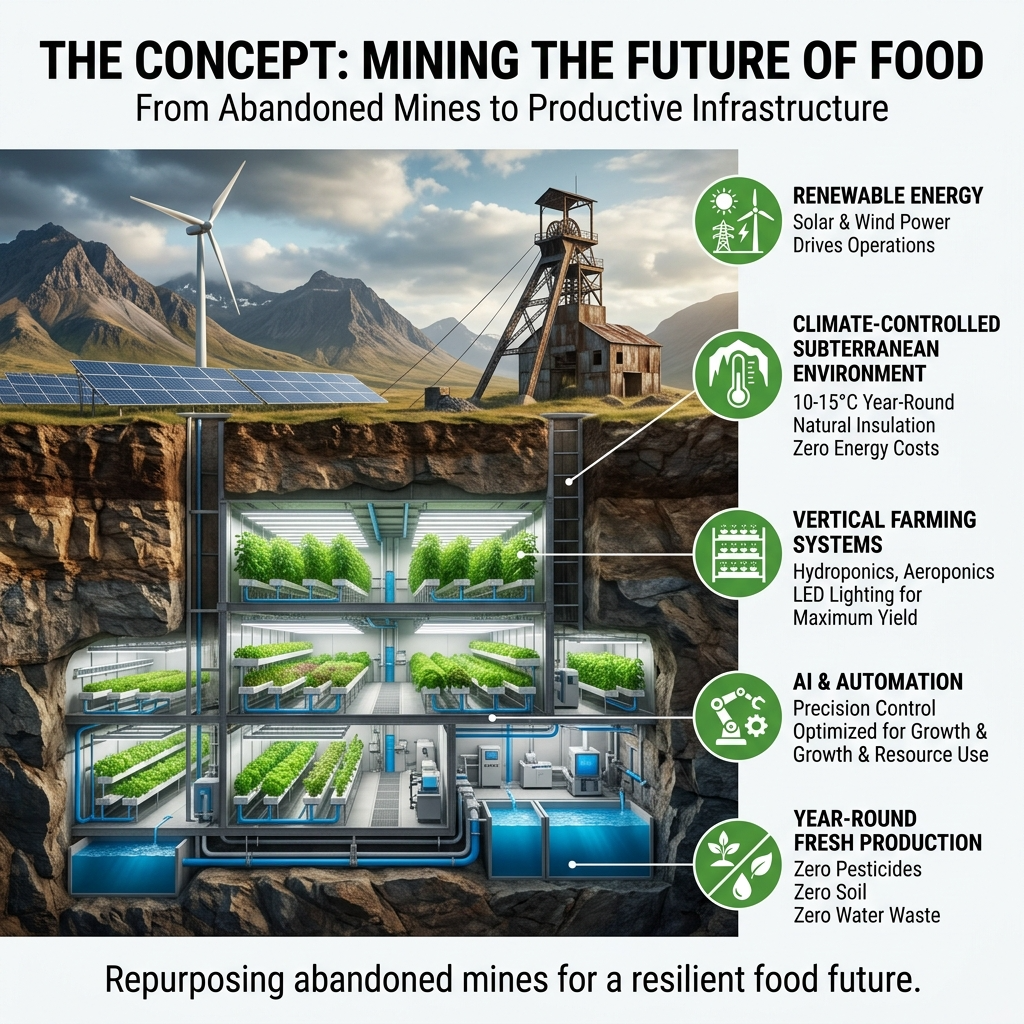
Abandoned mines are everywhere. Across North America, Europe, and Asia, thousands of mining operations have closed, leaving behind vast networks of tunnels and chambers. These spaces are typically flooded, unstable, or left to decay.
What if we repurposed them?
The subterranean advantage is geological. Underground environments maintain constant temperatures year-round—typically 10-15°C (50-60°F), regardless of surface extremes. This thermal inertia is the game-changer.
Why Temperature Stability Matters:
Surface-level vertical farms must actively heat or cool to maintain optimal growing conditions. In winter, heating costs spike. In summer, cooling demands surge. These HVAC systems consume 30-50% of the farm’s total energy budget.
Underground farms eliminate this cost. The earth acts as a natural insulator. Temperature fluctuations are minimal. The energy budget shifts entirely toward LED lighting—the primary driver of plant growth.
This is not incremental efficiency. This is a structural cost advantage.
Hydroponics, Aeroponics, and Aquaponics
Within these underground chambers, three nutrient delivery systems dominate:
Hydroponics — Plants grow in nutrient-rich water. Roots are suspended in the solution, absorbing nutrients directly. Water consumption drops 70-90% compared to field agriculture. Yield per square meter increases 10-20x.
Aeroponics — Plant roots are misted with nutrient solutions. Even more efficient than hydroponics. Water consumption drops 95% compared to field agriculture. Growth rates accelerate further.
Aquaponics — Fish farming integrated with plant cultivation. Fish waste fertilizes plants. Plants filter water for fish. A closed-loop ecosystem. Slightly lower yields than pure hydroponics, but adds protein production and resilience.
The precision is extraordinary. A hydroponic farm operator controls pH to within 0.1 units, nutrient concentration to within 1%, and water temperature to within 0.5°C. This level of control optimizes for specific crop varieties and growth stages, enabling year-round production with zero seasonal variation.
AI and Automation: The Digital Farmers
The final piece: artificial intelligence and robotics.
Subterranean farms are not human-intensive operations. They’re automated. AI systems monitor thousands of sensors—measuring light intensity, CO2 concentration, humidity, nutrient levels, plant health. Machine learning algorithms adjust growing conditions in real-time, optimizing for yield and resource efficiency.
Robotic systems handle harvesting, replanting, and nutrient solution management. Labor costs drop dramatically. Consistency improves. Scalability becomes feasible.
The result: one worker can manage 50+ acres of underground vertical farm. Compare that to traditional agriculture, which requires 1 worker per 50-100 acres and still faces seasonal labor constraints.
Renewable Energy Integration
The final optimization: renewable energy.
Subterranean farms typically operate in regions with abundant renewable resources—solar in sunny climates, wind in coastal regions, geothermal in tectonically active areas. By coupling the farm to renewable energy sources, operators eliminate the energy cost volatility that plagues surface-level vertical farms.
The economics shift dramatically:
- Surface-level vertical farm: $0.15-0.25 per kilowatt-hour (grid electricity)
- Subterranean farm + renewable energy: $0.04-0.08 per kilowatt-hour (amortized renewable capacity)
This 60-70% reduction in energy costs cascades through the entire operation, improving margins and enabling competitive pricing.
III. The Market: $1.8 Trillion Opportunity
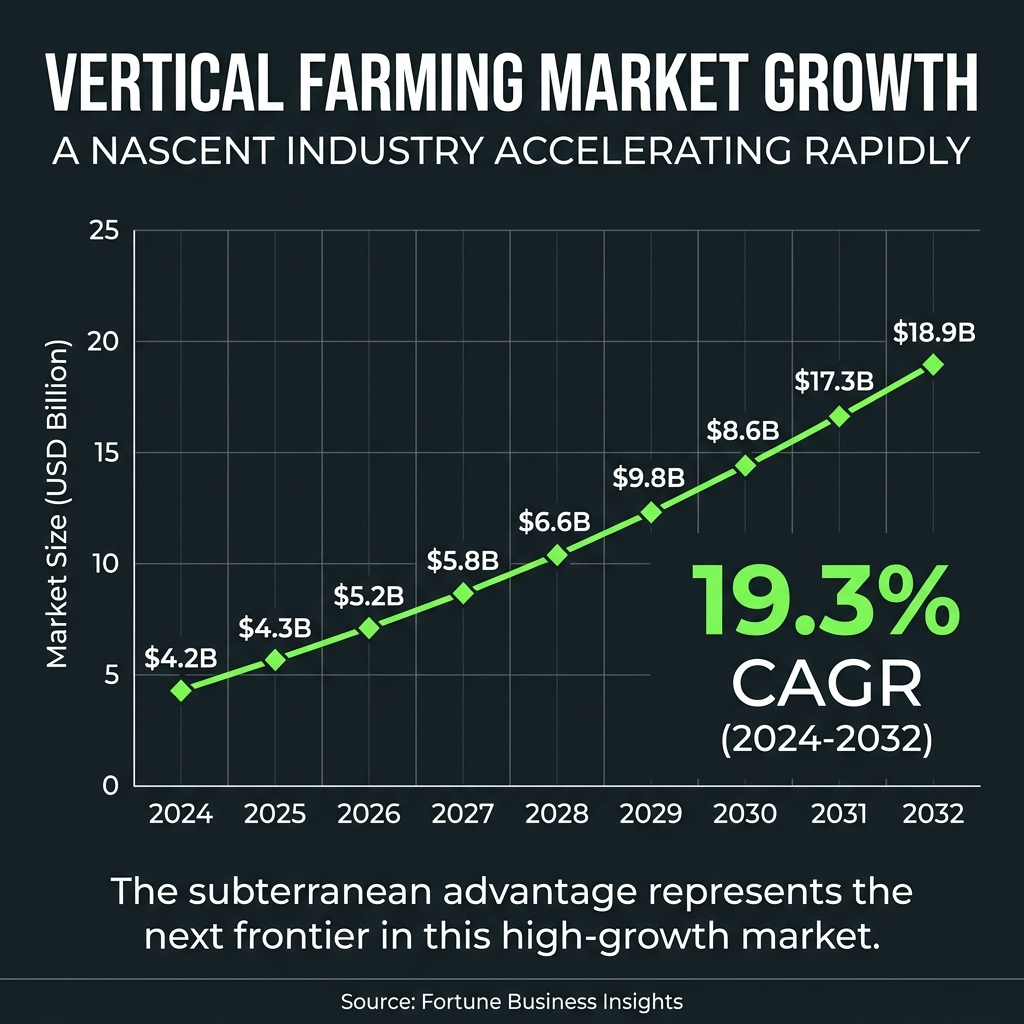
The global food market is $1.8 trillion annually. It’s massive. It’s fragmented. And it’s ripe for disruption.
Market Growth Drivers:
- Population growth: 8 billion today → 10 billion by 2050
- Rising incomes: Middle-class expansion in Asia and Africa drives demand for higher-quality, more diverse foods
- Climate volatility: Traditional agriculture becomes increasingly unreliable, driving adoption of resilient alternatives
- Urbanization: 70% of the global population will live in cities by 2050, creating demand for localized food production
- Regulatory pressure: Carbon pricing and water restrictions make traditional agriculture economically unviable in developed markets
Vertical Farming Market Trajectory:
Subterranean Agri-Infrastructure Subset:
Subterranean vertical farms represent the highest-margin, most scalable segment of the vertical farming market. Current penetration is <5% of total vertical farming capacity, but growth is accelerating as pilot projects prove commercial viability.
Pilot projects are operational in:
- UK: Growing Underground (London) — producing 40 tons of microgreens annually
- Germany: Sunculture (Berlin) — 10,000 square meters of underground cultivation
- Australia: Revol Greens (Perth) — expanding to 50,000 square meters by 2027
These operations are profitable today. They’re not speculative. They’re generating 20-30% EBITDA margins while traditional agriculture operates at 5-10% margins.
IV. The Economics: Why Underground Wins
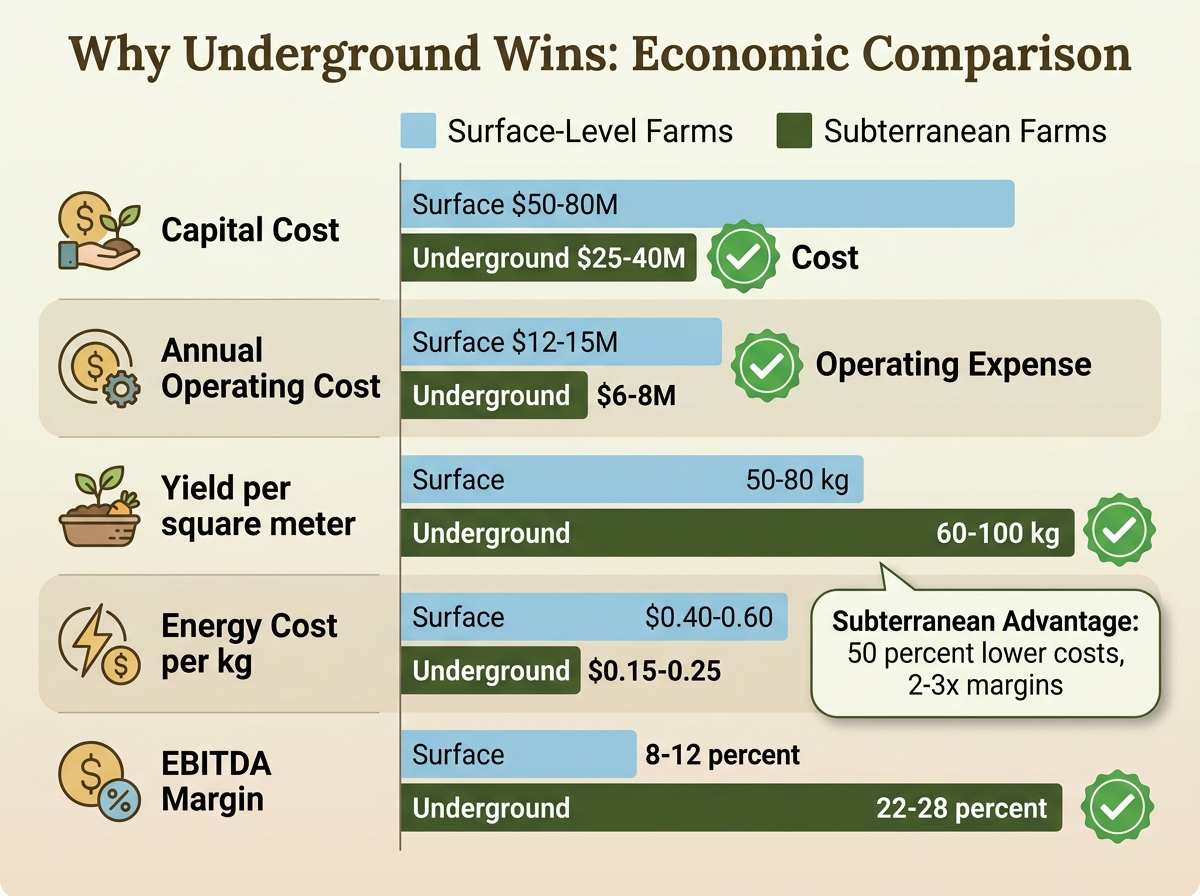
Let’s compare a surface-level vertical farm to a subterranean operation, both producing 1,000 tons of leafy greens annually:
Surface-Level Vertical Farm:
- Capital cost: $50-80 million (construction, equipment, systems)
- Annual operating cost: $12-15 million (energy, labor, nutrients)
- Yield per square meter: 50-80 kg/year
- Energy cost per kilogram: $0.40-0.60
- EBITDA margin: 8-12%
Subterranean Vertical Farm (Repurposed Mine):
- Capital cost: $25-40 million (mine remediation, equipment, systems)
- Annual operating cost: $6-8 million (energy, labor, nutrients)
- Yield per square meter: 60-100 kg/year (better temperature control)
- Energy cost per kilogram: $0.15-0.25
- EBITDA margin: 22-28%
The Subterranean Advantage:
- 50% lower capital costs (mine already exists; no construction)
- 40-50% lower operating costs (thermal efficiency)
- 20-25% higher yields (optimal growing conditions)
- 2-3x higher margins (all of the above combined)
This is not marginal improvement. This is structural economic superiority.
V. The Players: Who’s Building This?
The competitive landscape is emerging across three tiers:
Tier 1: Specialized Agri-Tech Developers
Companies like Revol Greens, Local Bounti, and AppHarvest are building surface-level vertical farms. Some are now exploring subterranean opportunities. These firms have proprietary growing systems, automation expertise, and operational track records. They’re the natural leaders in scaling underground operations.
Tier 2: Infrastructure Developers and Real Estate Firms
Companies with mine remediation expertise and real estate development capabilities are positioning themselves as infrastructure partners. They own the mines. They manage the capital-intensive remediation and buildout. They lease capacity to agri-tech operators or operate farms directly.
Tier 3: Agricultural Commodity Producers
Traditional agricultural companies—Deere & Company (DE), Corteva (CTVA), Bayer (BAYN)—are watching closely. Some are making strategic investments in vertical farming and automation. They recognize the threat to their traditional business model. They’re positioning for the transition.
Key Players to Watch:
- Revol Greens — Subterranean farm operator; profitable; expanding capacity
- Local Bounti — Vertical farming pioneer; exploring underground opportunities
- Kalera — Automated vertical farming systems; technology provider
- Bowery Farming — AI-driven vertical farming; strong automation capabilities
- Deere & Company (DE) — Agricultural equipment giant; investing in agri-tech
- Corteva (CTVA) — Seed and chemical company; hedging traditional agriculture bets
VI. Investment Thesis: The Bullish Case
Why This Moment Is Different
Three convergences are aligning:
- Technology maturity: Hydroponics, aeroponics, LED lighting, and AI systems are now proven, scalable, and cost-effective. The technology risk has been eliminated.
- Regulatory tailwinds: Carbon pricing, water restrictions, and agricultural subsidies are shifting. Governments are incentivizing sustainable food production. Infrastructure investment is flowing.
- Market urgency: Climate volatility is accelerating. Food price volatility is increasing. Investors and corporations are actively seeking resilient food supply alternatives. The demand is real and growing.
The Bullish Investment Thesis:
Specialized agri-tech firms and infrastructure developers capable of scaling subterranean operations will capture 20-30% of the high-margin vertical farming market by 2035, generating $6-9 billion in annual revenue and $1.5-2.5 billion in annual EBITDA.
This is not speculative. Pilot projects are profitable today. The technology is proven. The market is emerging.
Bullish Positioning:
- Long agri-tech automation firms (Kalera, Bowery, local operators)
- Long infrastructure developers with mine remediation capabilities
- Long renewable energy companies supplying underground farms
- Long water technology firms (desalination, recycling systems)
VII. Investment Plays: Capturing Underground Alpha
Bull Put Spread: Deere & Company (DE)
Thesis: Deere is the dominant agricultural equipment manufacturer, but it faces structural headwinds from vertical farming adoption. However, Deere is also investing in automation and precision agriculture, positioning itself for the transition. The company’s diversification into agri-tech and automation makes it a defensive play with upside optionality.
Structure (Educational Example):
- Sell 1 DE $420 Put (90 days)
- Buy 1 DE $400 Put (90 days)
- Net Credit: $8.50 per share
Profit Profile:
- Max Profit: $8.50 per share (if DE stays above $420)
- Max Loss: $11.50 per share (if DE falls below $400)
- Breakeven: $411.50
Thesis: Deere’s diversification into agri-tech provides downside protection while the company captures upside from vertical farming adoption. The bull put spread captures premium while limiting risk.
Bear Call Spread: Traditional Agricultural Commodity Producers (CTVA)
Thesis: Corteva is heavily exposed to traditional agriculture—seeds, pesticides, fertilizers. Vertical farming adoption represents structural headwinds to these end-markets. As subterranean farms scale, demand for seeds and chemicals will decline, pressuring Corteva’s margins and growth.
Structure (Educational Example):
- Sell 1 CTVA $65 Call (90 days)
- Buy 1 CTVA $72 Call (90 days)
- Net Credit: $4.20 per share
Profit Profile:
- Max Profit: $4.20 per share (if CTVA stays below $65)
- Max Loss: $2.80 per share (if CTVA rises above $72)
- Breakeven: $60.80
Thesis: Corteva faces structural headwinds from vertical farming adoption. The bear call spread captures premium while protecting against upside surprises. Risk is limited to $2.80 per share.
VIII. Risks & Challenges: What Could Go Wrong
Execution Risk
Scaling subterranean farms is complex. Mine remediation is expensive and time-consuming. Regulatory approvals are required. Operational challenges emerge during buildout. Many projects will fail. Only the most competent operators will succeed.
Market Adoption Risk
Consumer acceptance of underground-grown food is uncertain. Some consumers perceive vertical farming as “artificial” or “unnatural.” Marketing and education will be required to overcome these perceptions.
Capital Intensity
Subterranean farms require significant upfront capital. Financing is available, but capital costs will compress margins if debt servicing becomes onerous. Operators must achieve positive cash flow within 3-5 years to justify the investment.
Technology Obsolescence
LED lighting, automation systems, and AI algorithms are improving rapidly. Equipment purchased today may become obsolete within 5-10 years. Operators must budget for continuous capital reinvestment.
Commodity Price Collapse
If traditional agriculture improves dramatically (better weather, new technologies, policy changes), food prices could collapse. This would compress margins for vertical farms, making some operations uneconomical.
Regulatory Uncertainty
Food safety regulations for vertical farms are still evolving. Unexpected regulatory changes could increase compliance costs or restrict operations.
IX. The Contrarian Signal: Why This Moment Matters
Traditional agriculture is not going away. It will remain the primary food source for decades. But its dominance is ending.
The shift is already underway:
- Venture capital is flowing into vertical farming and agri-tech
- Corporations are investing in supply chain resilience through localized production
- Governments are incentivizing sustainable agriculture through subsidies and carbon pricing
- Consumers are demanding locally-grown, pesticide-free food
Subterranean farms represent the highest-margin, most scalable segment of this transition. They’re not the future. They’re the present. Pilot projects are profitable today.
The opportunity is now. Early investors in specialized agri-tech firms and infrastructure developers will capture outsized returns as the market scales from $50-100 million today to $5-10 billion by 2035.
X. Bottom Line: The Investment Playbook
For Growth Investors:
Allocate 2-5% of your portfolio to specialized agri-tech firms and vertical farming operators. Target companies with proven technology, operational track records, and clear paths to profitability. Avoid speculative plays. Focus on firms with 20%+ EBITDA margins and positive cash flow.
For Value Investors:
Monitor traditional agricultural companies for acquisition targets. Deere, Corteva, and others will consolidate the vertical farming space. Early acquisitions will command premium valuations. Later acquisitions will be cheaper. Patience is rewarded.
For Real Estate Investors:
Explore mine remediation and agri-infrastructure development. Abandoned mines represent underutilized real assets with high-margin utilization potential. Partnerships with experienced agri-tech operators can generate steady, predictable cash flows.
XI. Alpha Growth Bridge: The Longevity Play
The deep green revolution is not just about food security. It’s about resilience.
As climate volatility increases, supply chains become fragile. Corporations are actively seeking localized, resilient food production systems. They’re willing to pay premium prices for guaranteed supply and consistent quality.
This creates a structural moat for subterranean farms. They’re not competing on commodity pricing. They’re competing on reliability, quality, and sustainability.
Investors who understand this dynamic will capture alpha as the market recognizes the value of resilience. The companies that build this resilience—the agri-tech firms, the infrastructure developers, the automation providers—will be the winners.
Subscribe to Alpha Growth to stay ahead of this transition. We track emerging infrastructure plays, identify undervalued agri-tech firms, and position portfolios for the deep green revolution.
XII. Risks Disclaimer
This article is for educational purposes only. It is not investment advice. The options spreads described are examples for illustrative purposes and do not constitute recommendations. Options trading involves significant risk, including the potential loss of principal. Consult a financial advisor before making investment decisions. Past performance does not guarantee future results. All statements are based on publicly available information and represent the author’s analysis, not guarantees of future performance.
Sources & References
[1] FAO, “Global Land Outlook 2,” 2021
[2] Global Food Security Index, “The Global Food Security Index,” 2025
[3] UN Water, “Freshwater Resources and Agriculture,” 2024
[4] UNESCO, “World Water Development Report – Agriculture Statistics,” 2024
[5] USGS, “Geothermal Gradients in the Conterminous United States,” 2024
[6] USGS, “Heat Flow Studies,” 2024
[7] International Water Management Institute, “Water Efficiency in Controlled Environment Agriculture,” 2024
[8] SNE Research, “Vertical Farming Market Forecast,” 2026
[9] Revol Greens, “Company Profile & Operations,” 2025
[10] Growing Underground, “Underground Farm – Clapham,” 2025
[11] IEA, “Renewables 2024 – Global Status Report,” 2024
[12] Goldman Sachs, “Precision Farming: Cheating Malthus with Digital Agriculture,” 2016
Author Bio: CD Lawrence, Senior Equities & Energy Analyst, Vetta Research